There is a lot of research pointing to the fact that America needs an upgrade to its social safety net. Most worker benefits models in the U.S. were designed in the mid-twentieth century when the norm for many people was stable, long-term employment with a single employer—though this model was only ever really the norm for white men. It is estimated that somewhere around 17 million self-employed workers in the U.S. fall through the cracks, and numbers are only increasing as the independent workforce grows year over year.
As a nonprofit that, since 2001, has supported artists and culture workers (many of whom work as independent contractors), The Center for Cultural Innovation (CCI) has been acting on these emerging signals: commissioning research to identify and document the problems and paving the way for solutions.
Each of the three papers below highlight different aspects of the problem and solution that the Cookie Jar Collective aims to address. The first two were directly funded by CCI, and the third was authored in part by advisors to the Cookie Jar Collective’s design process.
1. Arts Workers in California: Creating a More Inclusive Social Contract to Meet Arts Workers’ and Other Independent Contractors’ Needs. (January 2021).
Written by: Jenny R. Yang, Amanda Briggs, Jessica Shakesprere, Natalie Spievack, Shayne Spaulding, and K. Steven Brown. Washington, DC: Urban Institute. Commissioned by Center for Cultural Innovation with support from the William and Flora Hewlett Foundation.
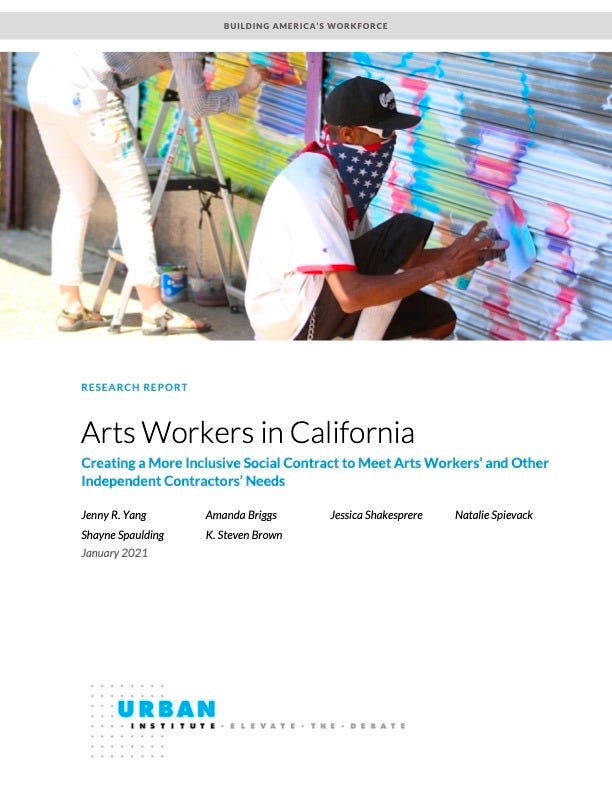
This paper argues that artists have long structured their work in ways that fall outside of standard W2 employment relationships, and thus serve as a test case for understanding and rethinking worker benefits policy more broadly. Statistically, arts workers in the U.S. are more than 3x more likely to be self-employed than the larger workforce; approximately 31% of arts workers are self-employed compared with approximately 10% of the broader workforce.
In 2020, the California legislature tried to address these issues with the passage of Assembly Bill 5. A.B. 5 aimed to ensure workers are not misclassified as independent contractors when they should be employees. Since its passage, the law has resulted in the passage of multiple clarifications exempting many occupations—including fine artists, recording musicians, and certain writers and photographers. While some employers are now required to convert their independent contractors to employees (thereby broadening access to rights, benefits, and protections), this law was not able to address the problem of worker rights in the ways that its originators had perhaps hoped.
These laws received immense pushback—including from independent contractor groups themselves who for various different reasons do not want to be classified as employees. It was intended to address the practice of many companies, including app-based tech companies, to classify workers as contractors as a cost saving measure, while still controlling many aspects of their work. However, worker classification should be a matter of work structure, not cost to the employer/contracting entity. The fact remains that most non-unionized artists and many freelancers are correctly classified as independent contractors. Some choose freelancing because they like the flexibility. Some need to choose freelancing for very real reasons such as caregiving or disability. Either way, their reality is one in which they do not have sufficient power to protect themselves against labor market risks such as chronically low wages, wage theft, unsafe working conditions, discrimination, a lack of access to social insurance programs, and more. Unfortunately, the lack of access to protections and insurance programs creates more volatility and more hurdles to accessing work in the arts and culture sector. These hurdles are even greater for those lacking generational wealth–disproportionately including communities of color.
The paper goes on to highlight other interventions beyond misclassification laws that have greater potential for positive change—specifically those that do not tie fundamental protections to worker classification status at all. The report explores promising and innovative policies to:
Provide greater economic security through inclusion in social insurance programs, such as unemployment insurance, workers’ compensation, and paid leave;
Increase the equity, safety, and dignity of work through workplace standards, including anti-discrimination, health and safety, and wage and hour protections; and
Strengthen workers’ ability to organize and build collective efforts to rebalance power and improve working conditions for freelance arts workers and other workers.
“New solutions are needed that include independent workers in social insurance programs, so as to protect artists, reduce barriers to entry to arts work by people of color, and enable arts workers to move more freely across hiring entities that struggle to afford employing them.”
Pages 45-51 are an incredible read providing a wide range of current and future projects, organizations, and ideas for extending worker protections to independent contractors. I 10/10 recommend you check it out.
Here are a few select highlights:
Further research on funding and structuring portable benefits systems for independent contractors:
Designing Portable Benefits: A Resource Guide for Policymakers (Reder, Steward, and Foster 2019)
Portable Benefits in the 21st Century (Rolf, Clark, and Bryant 2016)
Portable Benefits for an Insecure Workforce (Hanaeur and Rolf 2015): in this report, the authors proposed the “Shared Security System”, savings accounts in which workers would accrue employment benefits that they could carry between jobs. These accounts could provide unemployment benefits as well as other benefits traditionally provided by full-time, salaried jobs, such as workers’ compensation, paid leave, a matching retirement contribution, and a health insurance premium contribution
While independent contractors cannot claim unemployment, alternative models are being experimented with such as the Jobseeker’s Allowance (JSA)—proposed by the Center for American Progress, the National Employment Law Project, and the Georgetown Center on Poverty and Inequality—which could help stabilize the incomes of independent contractors through a small, short-term weekly allowance (approx. $170 / week) to support work search and preparation for independent contractors.
The right to collectively bargain is tied to employee status under the federal National Labor Relations Act, which means independent contractors are excluded from the right to unionize. However, freelancers can and should still build collective power to raise their working conditions through nontraditional organizing efforts.
One example is the National Domestic Workers Alliance, which advocates for better working conditions for domestic workers—such as nannies, house cleaners, and care workers—nationwide and has championed a National Domestic Workers Bill of Rights.
Independent contractors, including freelance arts workers, are not protected by federal or state wage and hour laws, which provide employees with a right to a minimum wage and overtime as well as additional protections.
On May 15, 2017, The Freelance Isn’t Free Act in NYC took effect which establishes and enhances protections for freelance workers, specifically the right to a written contract, timely and full payment, and protection from retaliation. The city’s Department of Labor has developed a model contract that can be used to meet the contract requirements of the act.
Finally, wage boards are an interesting and promising solution to many of the problems independent contractors face. Also called workers’ standards boards or industry committees, these boards investigate working conditions and challenges to make recommendations on issues including minimum pay standards by sector and occupation, benefits, training standards, and worker standards. See Wage Boards for American Workers (Madland 2018).
2. “Just Make It Better.” What Gig Workers Have to Say About Gig Work by Shelly Steward. (March 11, 2024).
This report is the Gig Worker Learning Project Phase 2 Report published by the Workers Lab, the national home for worker-centered innovation. It was co-written by the participant-researchers featured within the report (CCI was a co-funder of the Gig Worker Learning Project).
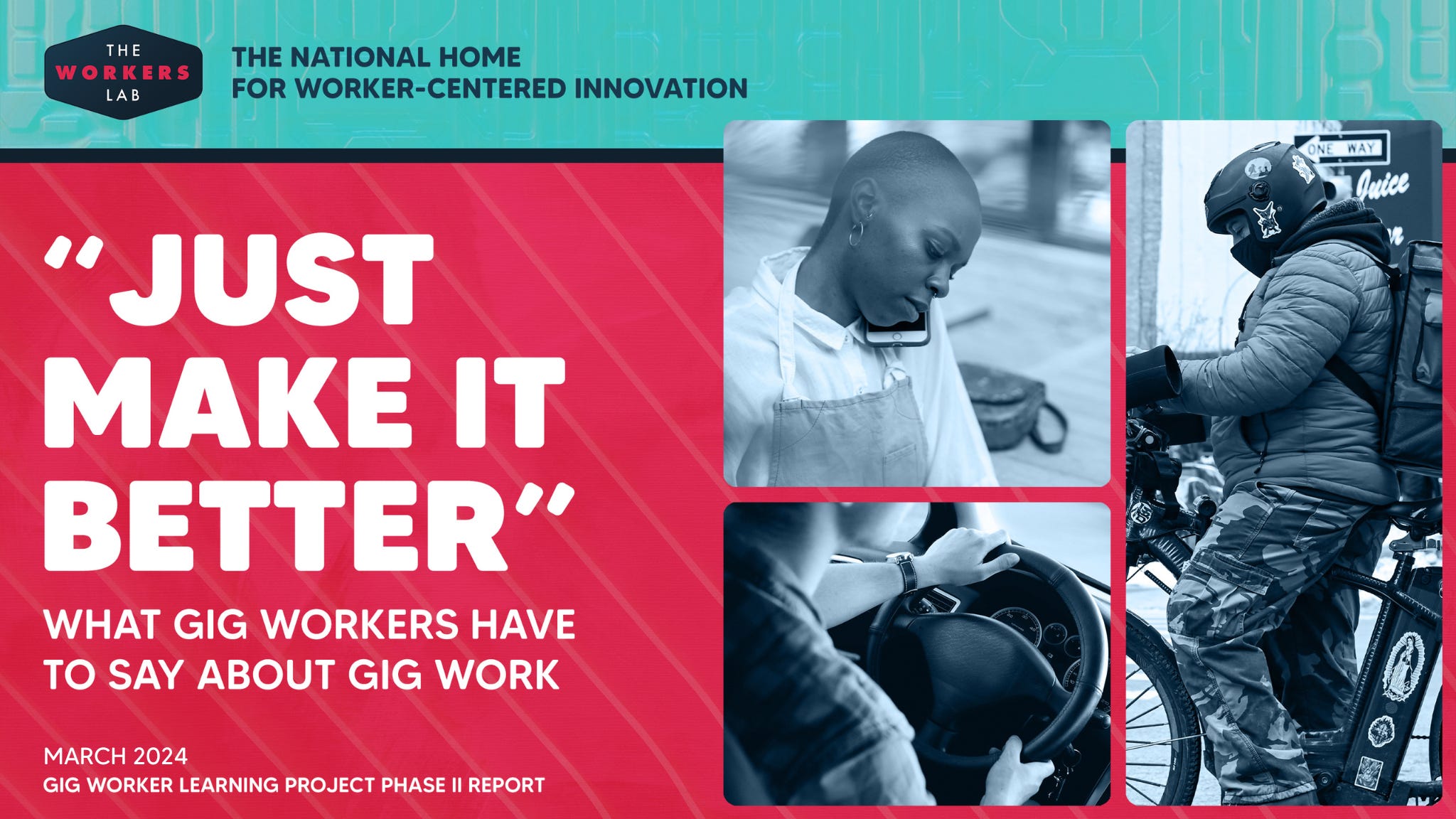
Broadening out from arts workers, these reports aim to demystify the “Gig Economy.” The Phase 1 Report is background research into who gig workers are, how they make money, how they use technology, how they use their income, and access to benefits and protections.
These reports aimed to build “knowledge and solutions centered on and developed by workers at the margins of today’s labor market.” For this reason, the Phase 2 participatory research report intentionally brought in people who are traditionally excluded from conventional research approaches: day laborers, domestic workers, creatives, crafters, agricultural workers, adjuncts, platform drivers, pieceworkers, sex workers, and seasonal workers. They conducted focus groups using a general framework of questions around what people do for work, the challenges they faced, and the solutions they envisioned. Topics included: income, risks, isolation, the myth of unskilled labor, and how technology has impacted the work.
Ideas for improving pay included universal minimum wages, more available and quality work, more resources for specific fields (especially arts), and guaranteed income programs. Regarding access to worker benefits, the participant-researchers were most interested in benefits that provide a financial cushion to near-term expenses or disruptions, including health insurance, paid sick time, and unemployment insurance than to longer term retirement savings.
One of the core assumptions and misunderstandings about gig work is that it is purely a “side hustle” that helps workers bring in “extra” income. However, research says that the vast majority of workers are actually using gig income to meet their basic needs. Therefore, more research is needed into understanding the implications for whether gig work is necessary or supplementary income (not required to meet basic needs). For these reasons, flexible (not retirement-locked) savings that members can access as-needed is a core pillar of the Cookie Jar Collective.
Finally, a resounding outcome of this research was actually experienced through the research process itself, as some participant-researchers reported:
“Coming together for this research process alone was exciting, and we found ourselves learning from each other and feeling less alone even in a virtual and mostly anonymous environment… I think a possible solution would be to continue to have discussions like this at the local level, regional level, state level, and then the national level to create more dialogue and to come up with an actual action plan and something that would assist this community.”
The report states, “Ideas originating from workers are much more likely to be successful since people doing the work understand both the needs that exist and the realities of the work they do. By coming together, workers can also learn what is possible and what is happening among other groups and in different parts of the country. On a practical level, coming together more formally could facilitate group purchasing of some benefits, like health insurance.”
Convening independent workers and their allies has been and continues to be a central part of this work.
3. Principles for Worker-Centered Benefits Programs. (February 1, 2025).
The Center for Labor and a Just Economy at Harvard Law School by Former Biden Administration Department of Labor Appointees Diana Boesch, Michele Evermore, Katherine Eyster, Sarah Jane Glynn, Gayle Goldin, Tanya Goldman, Ali Khawar, Jesse Lawder, Raj Nayak, Patrick Oakford. (Raj Nayak and Ali Khawar attended our Cookie Jar Collective Co-design in 2025 and have been trusted advisors to the project).
Finally, this report summarizes ten principles policymakers should use to guide the design and implementation of portable benefits programs. It rests on the idea that all people who work—regardless of employment status–should have the support they need to ensure that they and their families can thrive as our labor market continues to evolve.
Benefits are important to promote the economic security, health, and mobility of workers and their families, yet the existing benefits systems in the United States exclude tens of millions of workers from accessing work-related benefits, making them financially vulnerable when they experience common life events.
The report focuses on universal, portable benefits, a solution where individual workers earn benefits that follow them throughout their working lives—rather than being provided by or through individual employers for the duration of each specific job.
The principles are described in further detail in the report, but benefits should be available and inclusive; center workers; be equitable; meaningful; easy to access; and include worker protections.
Some of the most inspiring and innovative ideas from this report include:
The benefits workers receive should be proportional to their hours worked, ensuring reasonable coverage for part-time and full-time workers.
Not only should workers be able to retain and transfer their earned benefits when they change employers or are unemployed, they should also have access to benefits that reflect their work across multiple jobs or contracts. This aggregation ensures workers’ benefits account for the full scope of their work.
Benefits programs should be sustainably, responsibly, and fairly funded through one or more sources, including by those who are employing or engaging workers. Depending on the program, those sources can include, but are not limited to, contributions from workers, customers, employers, and public funds.
Benefits programs should pool the risks and responsibilities of financing a program across a group of contributors (such as multi-employer plans, union trust funds, or state or federal programs). The researchers argue that, for this reason among others, worker benefits should be publicly administered whenever possible.
Our aspirations for building Cookie Jar Collective is to make it easy and essentially inexcusable for our governments not to provide independent contractors access to basic worker protections and benefits. The learnings from these three research papers—among many others—give us a glimpse into what problems need to be addressed.
They also highlight what types of solutions these workers seek, and how these solutions can be implemented into public policy for longevity and sustainability of worker protections and benefits as the labor market continues to change and the gig economy continues to grow.
Thank you all for reading! We’ll continue to share more of the research behind the Cookie Jar Collective and update you with opportunities to get involved. You can always reach us at r2i-lab@cciarts.org with any questions or ideas you might have for worker-centered benefits.